DIY Soft-Close Toilet Seat Replacement: Bowl Sizing, Top-Fixing Anchors & Plastic Disposal
- 1Bathroom toilet seats and covers endure continuous mechanical loads and moisture, leading to loose hinge brackets, failed soft-close dampers (slamming lids), hairline structural cracks, and stubborn uric acid discoloration over time.
- 2The most critical preliminary step for DIY replacement is measuring the ceramic toilet bowl.
- 3A distance of 420–440 mm from the mounting bolt holes to the front rim indicates a Round (Medium) bowl, whereas 460–490 mm designates an Elongated (Extra-large) bowl compatible with standard modern bidet fixtures.
- 4Additionally, skirted concealed-trap toilets require top-fixing expanding rubber anchors inserted from above, while open-trap toilets utilize bottom wing nuts.
- 5Detached old toilet seats are made of composite PP or Duroplast (UF) resin contaminated with bathroom bacteria, making them non-recyclable plastic.
- ✓Stainless steel hinge brackets and bolts should be sorted into scrap metal, while the bulky seat itself must be sealed in a municipal general trash bag (50L/75L) or tagged with a municipal bulky waste sticker (₩2,000–₩3,000).
Follow these steps
- 1
Step 1 (Measure Bowl Dimensions & Identify Mounting Style): Measure the distance from the center of the mounting bolt holes to the front edge of the bowl with a tape measure. 420–440 mm indicates 'Round (Medium)', while 460–490 mm indicates 'Elongated (Extra-large)', with a standard 140 mm hole pitch. Inspect whether the bowl is a smooth skirted concealed-trap model (requiring top-fixing rubber anchors) or an open-trap model (requiring bottom nuts) before purchasing a soft-close seat.
- 2
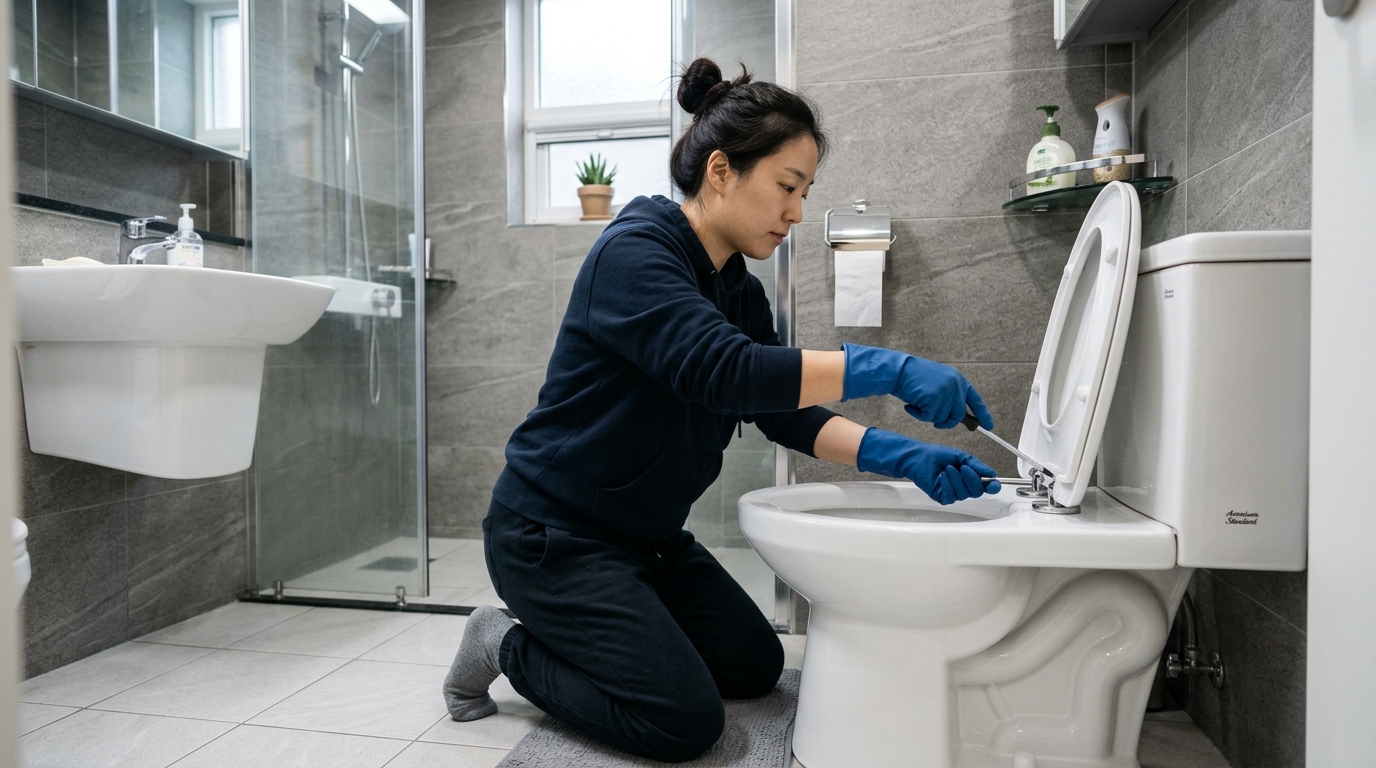
Step 2 (Loosen Hinge Bolts & Remove Anchors): Wearing protective rubber gloves, pop open the hinge bolt decorative caps with a flathead screwdriver and loosen the mounting screws counter-clockwise with a Phillips screwdriver. For skirted toilets, pull the black expanding rubber anchor sleeves out of the mounting holes using needle-nose pliers; for open toilets, unthread the plastic wing nuts from beneath the bowl.
- 3
Step 3 (Deep-Clean Hidden Limescale & Dry Rim): Scrub away years of hidden yellow limescale, uric acid stains, and bacteria around the vacant mounting holes using diluted bathroom disinfectant and a stiff scrub brush. Rinse thoroughly and wipe the ceramic surface completely dry with a microfiber cloth so the new mounting template will not slip.
- 4
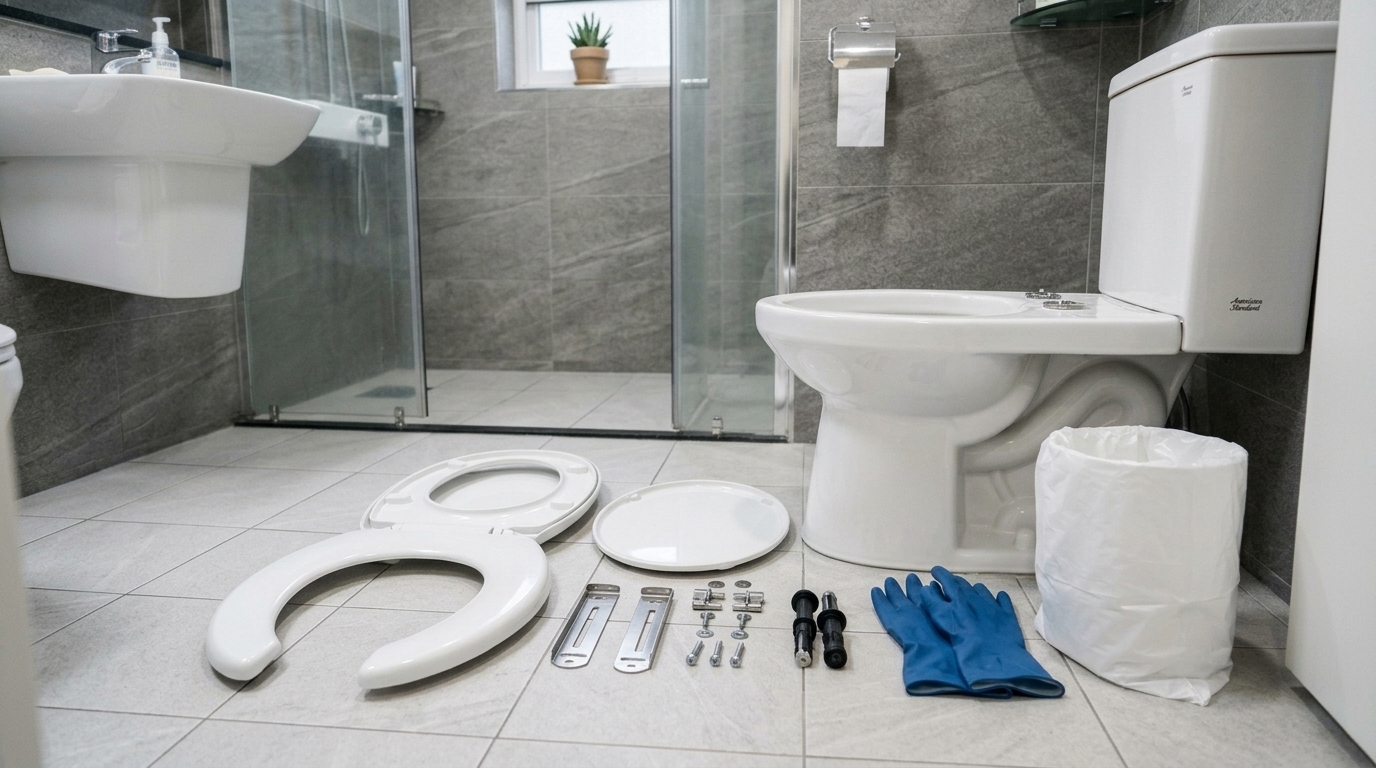
Step 4 (Insert Top-Fixing Anchors & Align Quick-Release Seat): For skirted toilets, push the expanding rubber anchors fully into the bowl holes, position the stainless steel sliding brackets and washers, and loosely tighten the bolts to 80%. Snap the new slow-close seat onto the hinge posts, adjust front and lateral alignment flush with the bowl rim, press the central quick-release button to detach the seat, and fully torque the screws down before clicking the seat permanently in place.
- 5
Step 5 (Sort Metal Hardware & Bag Composite Seat): Detached toilet seats and covers are non-recyclable composite Duroplast/PP plastics contaminated with organic waste. Separate stainless steel brackets, metal plates, and screws into scrap metal recycling, and discard old rubber anchors in general trash. Seal the bulky plastic seat inside a 50L–75L municipal general trash bag, or obtain a municipal bulky waste sticker (₩2,000–₩3,000) from your district office if the seat exceeds bag capacity.
Frequently asked question
How do I tell if my toilet is a skirted (concealed trap) or open-trap model?
Look at the sides of your toilet bowl. If you can see the contoured outline of the S-trap and can reach your hand underneath the back to feel the mounting nuts, it is an open-trap bowl. If the exterior is completely flat and skirted with no bottom access, it is a skirted concealed-trap bowl, which strictly requires top-fixing rubber expansion anchors installed from above.
Why does my toilet lid slam shut, and what is the lifespan of a soft-close damper?
The internal silicone fluid damper inside the hinge assembly has either leaked or suffered internal gear wear from repetitive friction and body weight, causing complete loss of hydraulic resistance. The typical lifespan of a soft-close damper is 3–5 years under average household use. Because individual damper cartridges are rarely serviceable, replacing the entire seat assembly is the standard solution.
What precautions should I take when switching from an electronic bidet to a standard soft-close seat?
Managing the T-valve and water supply line is critical. Turn off the wall angle stop valve, unplug the bidet cord, and press the side release latch to slide off the bidet unit. Remove the dedicated bidet water hose and T-adapter, reconnecting a direct braided supply line to the toilet cistern to prevent high-pressure leaks. The detached electric bidet unit can be recycled for free as small household e-waste.
Why can't discarded plastic toilet seats be recycled in plastic bins?
Toilet seats are engineered from durable composite plastics—such as polypropylene (PP), rigid Duroplast (UF thermosetting urea resin), and integrated silicone dampers. Furthermore, intense biological contamination and uric acid encrustation render them unsuitable for mechanical recycling facilities. They are classified as municipal combustible solid waste requiring general trash bagging or bulky waste stickers.