Apartment Water Leak Insurance Claims: Restoration & Heavy Waste Disposal
- 1Dealing with a ceiling or floor water leak in multi-family residences (apartments, condominiums, and villas) involves complex insurance mechanisms across both Korean and global standards.
- 2Under typical property policies (equivalent to HO-6 Condo Owner or HO-4 Renters insurance), personal liability coverage protects against third-party damages (such as downstairs drywall, wallpaper, and furnishings), subject to deductible policies (₩200,000 vs ₩500,000 in Korea / $500–$1,500 globally).
- 3Internal structural and flooring repairs require a dedicated Water Discharge & Leakage rider (Dwelling Coverage A).
- 4Crucially, urgent leak detection diagnostics and pinpoint pipe repairs qualify as statutory 'Loss Prevention Costs' under commercial maritime/insurance law.
- 5For leased properties, landlords must maintain dedicated Landlord Liability endorsements.
- ✓Furthermore, water-damaged plasterboard, moldy drywall, and warped bulk furniture must be handled via specialized municipal non-combustible sacks and bulky waste permits to prevent environmental contamination and legal fines.
Follow these steps
- 1
Step 1 (Emergency Valve Shut-off & Multi-Angle Evidence Recording): Immediately shut off the main water meter valve (supply isolation) to arrest escalating discharge. Document high-definition photos and video footage capturing the exact leak origin (under-sink compression valves, boiler manifolds, or bathroom floor drains) and all downstream damage (ceiling water rings, soggy drywall, blistering paint, and ruined electronics/carpets).
- 2
Step 2 (Policy Verification & Registered Insured Dwelling Address): Examine active homeowner, tenant (HO-4), or umbrella insurance contracts to verify Personal Liability endorsements and registered dwelling address match. (In Korean policies, pre-April 2020 terms carry a ₩200,000 deductible while post-2020 terms impose ₩500,000 for water leaks; non-resident landlords require dedicated Landlord Liability riders).
- 3
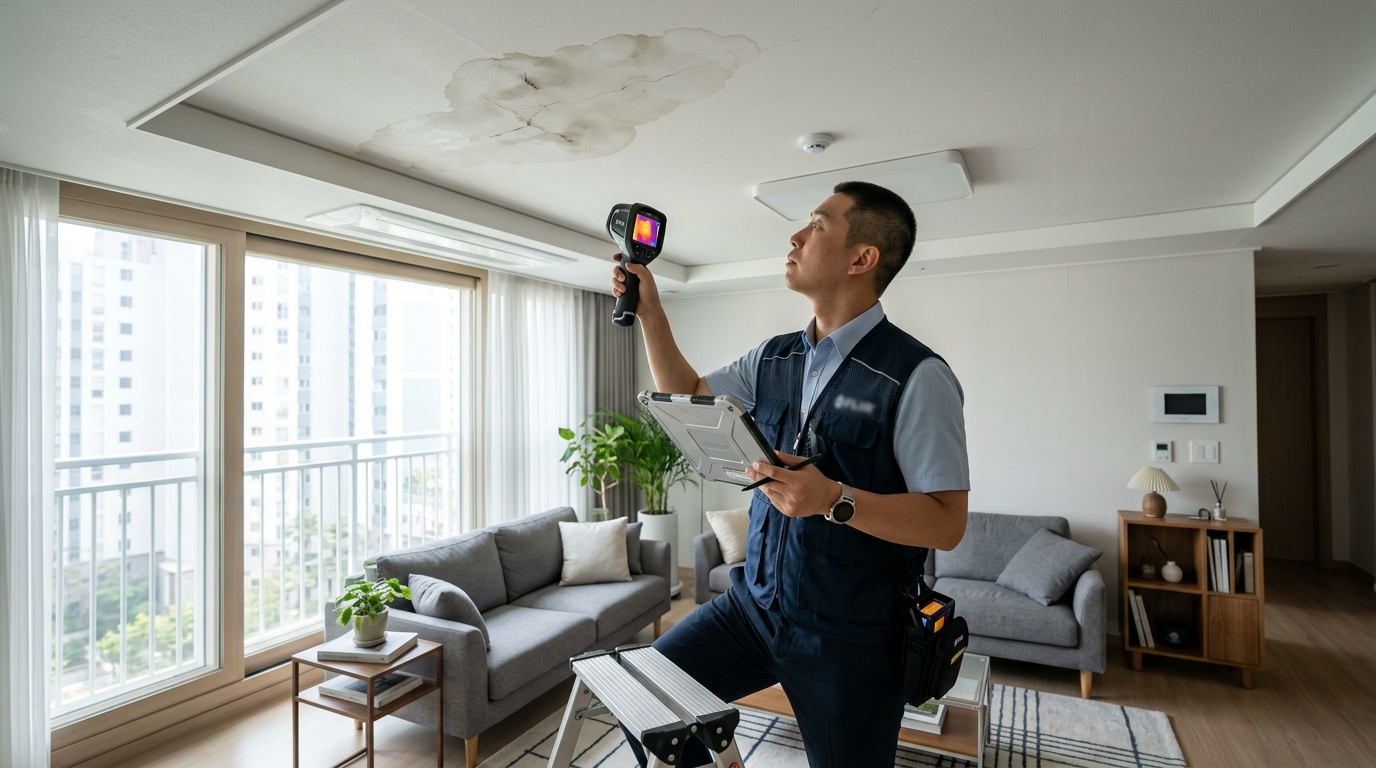
Step 3 (Immediate Claim Filing & Certified Loss Prevention Inspection): File the formal claim immediately via your insurer's 24/7 hotline or mobile portal. Hire a certified leak detection firm equipped with acoustic listening discs, tracer gas, and infrared thermography. Legitimate costs incurred to pinpoint the breach and perform urgent spot pipe repairs are recoverable as statutory 'Loss Prevention Expenses' under insurance law—ensure you secure an itemized diagnostic report and receipt.
- 4
Step 4 (Internal Damage Claim & Adjuster Documentation Package): For internal flooring, subfloor, and wall water damage within your own unit, submit a claim under the 'Water Discharge Facility Leakage' rider (HO-6 Dwelling Coverage). Provide the claims adjuster with the comprehensive submission package: [Certified Leak Opinion Letter + Detailed Contractor Estimate + Before/After Photo Matrix + Resident Proof + Payment Receipts].
- 5
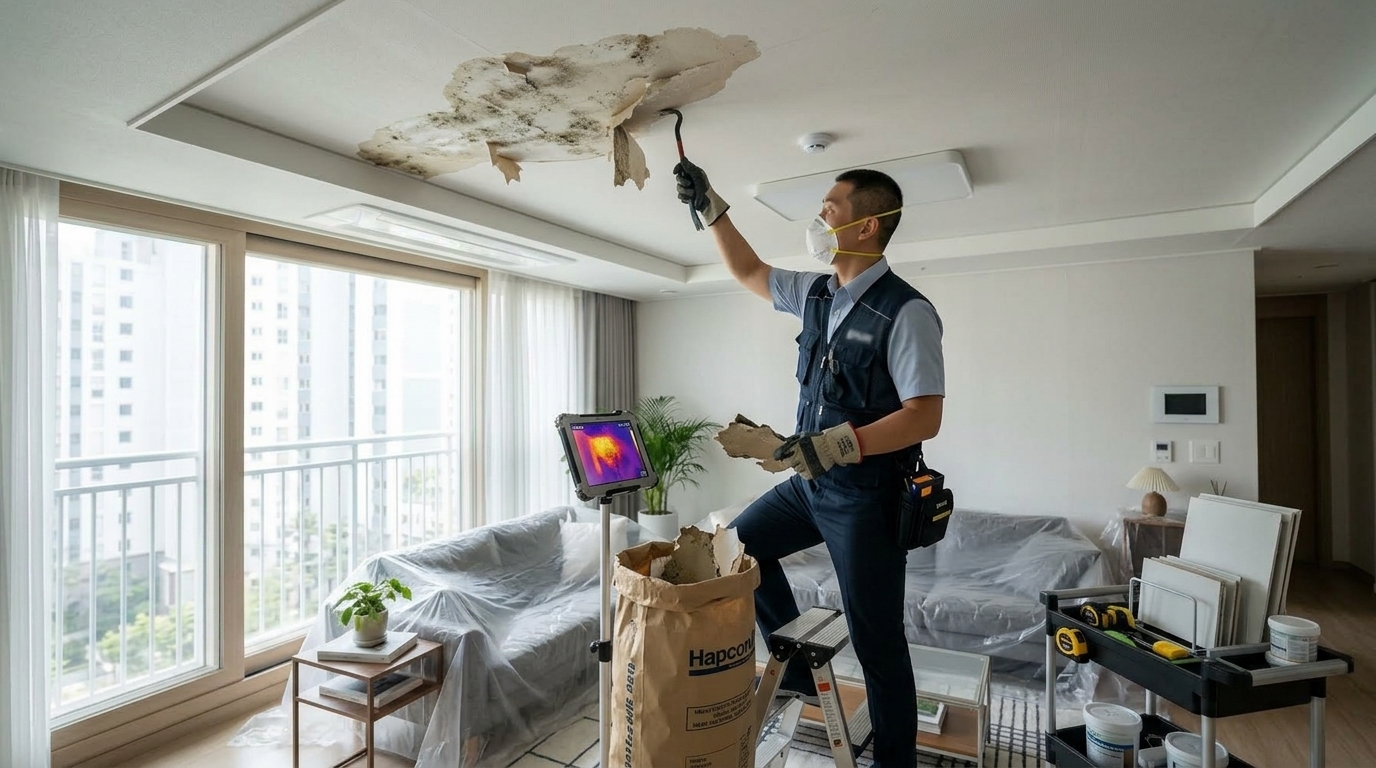
Step 5 (IICRC Mold Remediation, Drywall Demolition & Regulated Disposal): Strip water-saturated drywall, moldy plasterboard, and contaminated insulation within 48 hours following standard remediation protocols. Bag non-combustible demolition debris into municipal heavy-duty PP sacks (non-combustible waste). Swollen, irreparable bulky items (couches, mattresses, MDF cabinets) must be registered for municipal bulky waste stickers rather than abandoned on curbs.
Frequently asked question
Does personal liability insurance cover repairing the upper unit's leaking pipe in addition to lower unit drywall repairs?
Personal liability insurance fundamentally indemnifies third-party property damages. However, expenses directly required to locate the rupture (thermal/acoustic detection) and execute emergency spot pipe repairs qualify as statutory 'Loss Prevention Costs' (Commercial Act Art. 680 / global mitigation clauses), as they halt escalating damage to lower units. Aesthetic bathroom remodels and whole-house pipe replacements are strictly non-reimbursable.
How are water leaks handled in leased properties between landlords and tenants?
Under standard lease agreements (such as Korean Jeonse/Wolse or global tenancies), structural pipe deterioration and aging infrastructure are the legal responsibility of the property owner (Landlord). Landlords leasing units must maintain a dedicated 'Landlord Liability Rider' because personal liability policies generally restrict coverage to the policyholder's primary residence. However, if a leak stems from tenant negligence (e.g., leaving a tap open or damaging a fixture), the tenant's personal liability policy applies.
If multiple household members hold personal liability insurance, is the deductible eliminated?
When two or more family members living in the same registered household possess active personal liability riders, claims are settled on a pro-rata (proportional) basis between insurers. This double-coverage structure can offset and reduce the out-of-pocket deductible to ₩0. Nonetheless, the total payout can never exceed the actual verified repair expenditure (Principle of Indemnity).
What is the proper procedure for disposing of moldy drywall, wet insulation, and waterlogged furniture?
Water-saturated plasterboard, gypsum drywall chunks, and cracked tiles are classified as non-combustible construction waste and must be packed into heavy-duty PP sacks (available at local marts and community centers). Warped, unsalvageable bulky furniture (mattresses, fabric sofas, swollen particle-board shelving) must be declared online via district waste portals for official bulky waste collection stickers.