Broken Drawer Slide Track & Bearing DIY Replacement and Scrap Metal Guide
- 1When a bedroom dresser, vanity, or kitchen cabinet drawer grinds, jams halfway, or drops tiny steel balls onto the floor, the internal ball-bearing retainer cage of the 3-section drawer slide has failed.
- 2Forcing a jammed drawer bends the steel channels and risks the heavy drawer crashing onto your feet.
- 3Instead of discarding the furniture, simply measure the closed length of the existing track (standardized in 50mm increments such as 300mm, 350mm, or 400mm) and install a new pair of 3-section ball-bearing or soft-close damper slides for under ₩6,000 in 15 minutes.
- ✓This guide covers releasing the black plastic disconnect levers (pressing one side up and the opposite side down), aligning inner and outer rails level, reinforcing stripped particleboard screw holes with toothpicks, and properly sorting degreased steel tracks into scrap metal recycling while bagging broken plastic clips and loose steel bearings in municipal trash.
Follow these steps
- 1
Pull Drawer Out Fully and Press Plastic Disconnect Levers: Pull the drawer all the way open to expose the black plastic release levers on both side tracks. Because left and right slides are mounted symmetrically, push one lever up and press the opposite lever down simultaneously while pulling the drawer straight out (for old white epoxy roller tracks, pull out fully and tilt the front upward to lift out).
- 2
Pencil Mark Reference Lines, Unscrew Old Rails, and Measure Length: Before unscrewing the damaged tracks, lightly trace their top edge with a pencil inside the cabinet and along the drawer sides to preserve level alignment. Remove all Phillips screws to detach the tracks, then measure the fully closed rail length in millimeters (e.g., 300mm, 350mm, 400mm) and width (35mm or 45mm) to match your replacement pair.
- 3
Separate New Inner/Outer Rails and Repair Stripped Screw Holes: Extend the new 3-section ball-bearing slide fully and press the rear plastic lever to slide out the narrow inner rail (drawer member) from the wide outer rail (cabinet member). If existing particleboard or MDF screw holes are stripped, dip 2–3 wooden toothpicks in wood glue, tap them into the hole, snap them flush, and drive the new screws directly in.
- 4
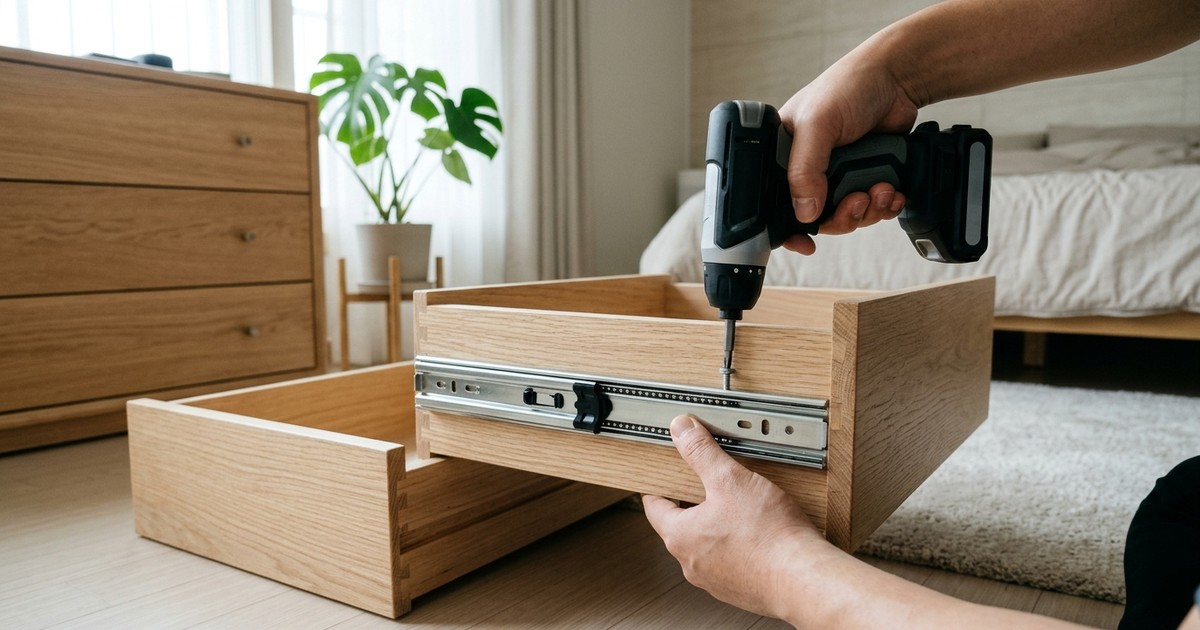
Fasten Outer Rails to Cabinet and Inner Rails to Drawer Box: Align the wide outer rails along the pencil marks inside the cabinet (set back 2–3mm from the front edge), secure one screw in the oval adjustment slot first to check levelness, and lock down with screws in the fixed round holes. Fasten the narrow inner rails flush along the left and right sides of the drawer box.
- 5
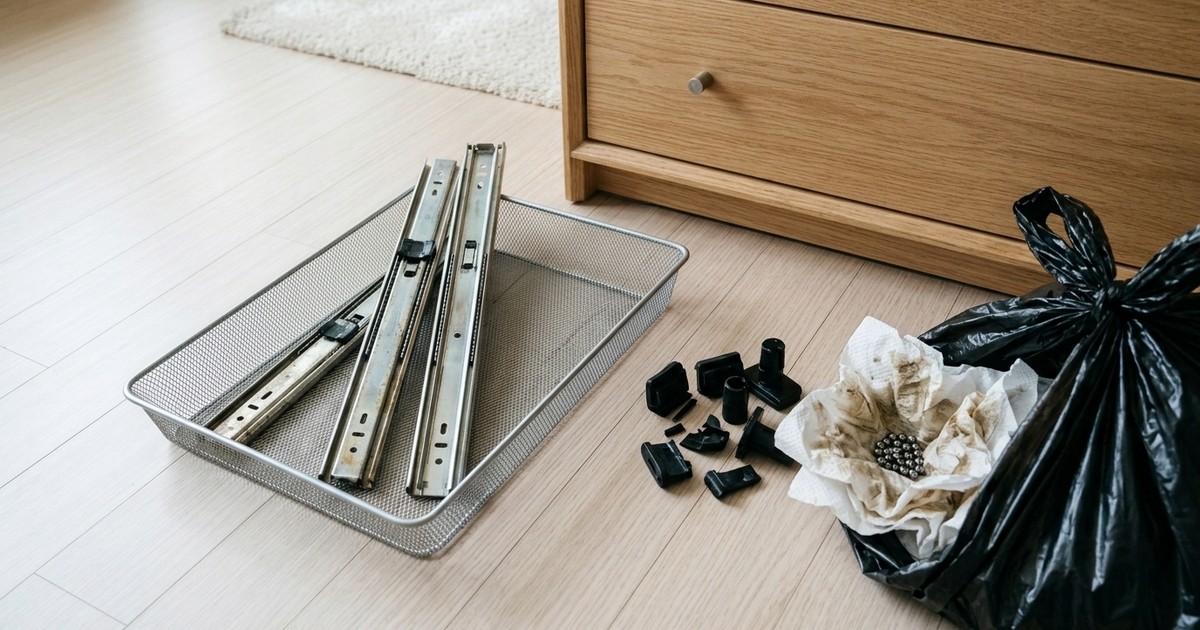
Slide Ball-Bearing Cage Forward, Insert Drawer, and Sort Waste: Before sliding the drawer in, push the internal ball-bearing retainer cage all the way to the front tip of the cabinet rail so it engages smoothly with the drawer track. Align both sides horizontally, push the drawer firmly closed until it clicks, and test 2–3 times. Wipe heavy grease off the old steel rails with paper towels and place the metal tracks into curbside scrap metal recycling; wrap grease-stained tissues, broken plastic stoppers, and loose tiny steel balls in paper and dispose of them in a standard municipal trash bag.
Frequently asked question
When buying replacement drawer slides, do I measure the extended length or the closed length?
Always measure the 'fully closed (collapsed)' length of the slide—or measure the front-to-back depth of the drawer box side panel. Drawer slides are sold in standard 50mm increments (250mm, 300mm, 350mm, 400mm, 450mm, 500mm). Choose the size equal to or slightly shorter than your drawer box depth.
Can I upgrade old white 2-section epoxy roller slides to modern 3-section ball-bearing slides?
Yes, provided there is a side clearance gap of 12.5–13mm per side (25–26mm total width clearance) between the drawer box and cabinet opening. However, because bottom-mount epoxy roller tracks and side-mount ball-bearing slides have slightly different tolerances, replacing like-for-like is easiest if the side gap is tight.
A few steel balls fell out of the drawer track. Can I pop them back in and reuse the rail?
Once steel balls start dropping out, the internal metal retainer cage or end-stop has already deformed or fractured. Pushing the balls back in is only temporary; they will pop out again under load and jam the drawer completely. Always replace both left and right slides as a matched pair.
How should I sort and dispose of the greasy old steel drawer slides and loose ball bearings?
The drawer slide channels are 100% cold-rolled steel or stainless steel; wipe off excess grease with a paper towel and place the metal rails into curbside scrap metal/can recycling bins. Meanwhile, grease-soaked paper towels, broken plastic end-caps, and tiny loose ball bearings cannot be processed by sorting conveyors and must be wrapped in paper and placed in a standard municipal trash bag.