Fishing Gear Cleanup & Disposal Guide: Hooks, Lead Sinkers & Lines
- 1Discarded fishing tackle, lead weights, tangled lines, and leftover organic baits cause severe puncture injuries and ecological destruction if abandoned or improperly binned.
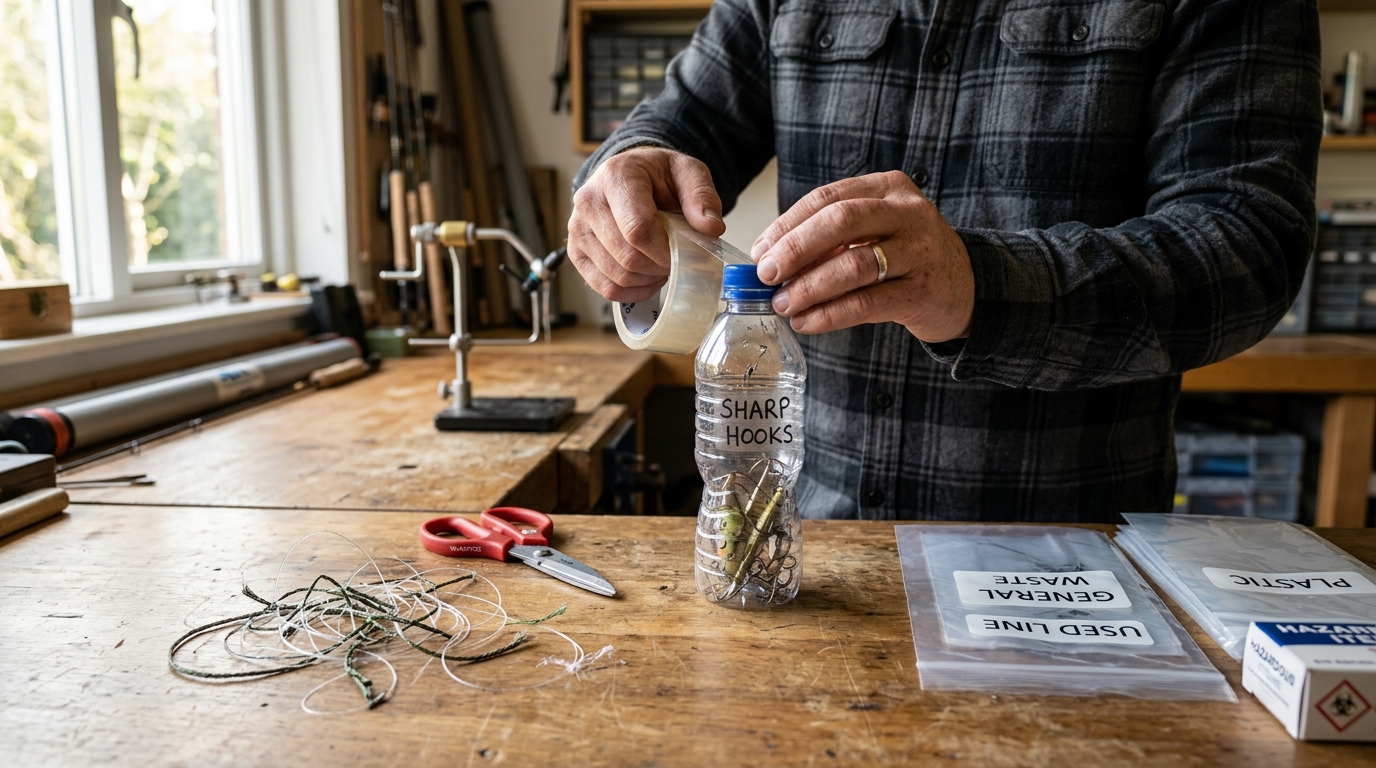
- 2Sharp hooks and treble lures must be sealed inside rigid plastic bottles with taped caps to protect sanitation workers from puncture wounds and tetanus infections.
- 3Toxic heavy-metal lead sinkers should be returned to tackle shop recycling bins or placed in non-combustible waste bags, while tough monofilament and braided fishing lines must be cut into 5cm pieces with scissors before bagging to prevent deadly entanglement of seabirds and wildlife.
- ✓Broken carbon rods require bulky waste stickers or cutting before household trash disposal.
Follow these steps
- 1
Seal sharp hooks & lures inside plastic bottles: Collect sharp single hooks, treble hooks, and jig heads inside a clean rigid plastic water bottle, seal the cap with duct tape, and place it at the center of a general trash bag.
- 2
Safely dispose of toxic lead sinkers: Heavy-metal lead (Pb) sinkers contaminate soils and waterways; return spent lead sinkers to dedicated tackle shop drop boxes or place them in municipal non-combustible PP bags (eco-friendly steel/tungsten weights go into scrap metal bins).
- 3
Cut tangled fishing lines into short 5cm segments: Nylon monofilament and braided PE lines cannot be recycled as plastic. Because long loose loops entangle and amputate seabird limbs, snip lines into 5–10cm pieces with scissors before bagging in general trash.
- 4
Double-bag leftover live bait & dough: Never dump excess krill, worms, or dough bait directly into waterways as it causes severe eutrophication and triggers fines; wrap leftover bait securely in newspaper or plastic pouches and dispose in general trash to seal in odors.
- 5
Dispose of broken rods & heavy gear bags: Carbon fiber and fiberglass rods are non-recyclable composites; rods exceeding 1 meter require municipal bulky waste stickers (₩2,000–₩3,000) unless safely cut down for trash bags; cloth gear bags belong in general trash.
Frequently asked question
Can discarded fishing hooks and metal lures be recycled with scrap metals or cans?
No. Small fishing hooks fall off industrial magnetic sorting belts and severely injure manual sorters by puncturing work gloves, causing dangerous tetanus infections. They must be safely sealed inside hard plastic bottles and discarded in general municipal trash bags rather than scrap metal.
Why shouldn't heavy lead sinkers be tossed into regular trash bags?
Lead (Pb) is a bioaccumulative toxic heavy metal. When incinerated in standard municipal trash plants, lead vaporizes into toxic airborne emissions or leaches into groundwater in landfills. It must be returned to tackle store recycling drop-offs or placed inside non-combustible waste bags.
Can leftover live bait like lugworms or krill just be dumped back into the sea or river?
Releasing a few live native worms is harmless, but dumping blocks of thawed commercial krill, salted imported worms, or fermented dough bait causes rapid local eutrophication, oxygen depletion, and fish kills. All leftover packaged bait must be retrieved and bagged as trash.